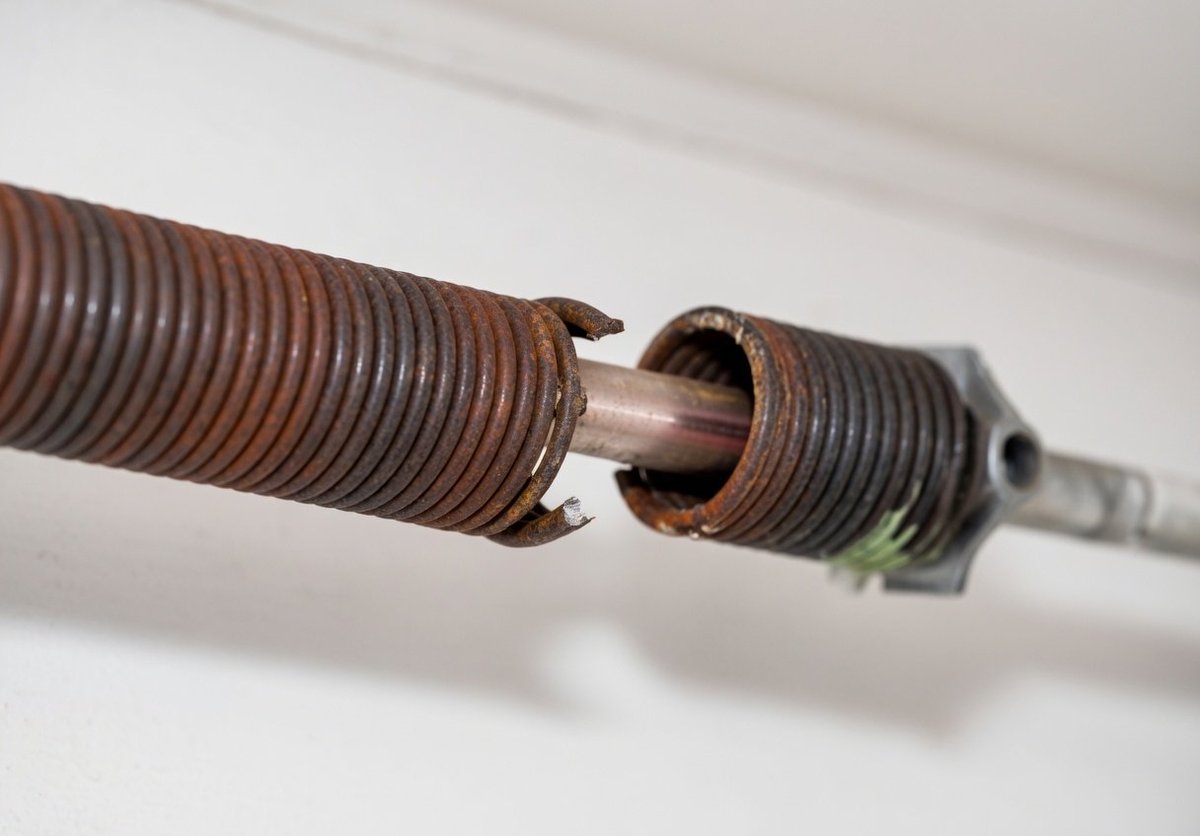
What Is a Garage Door Torsion Spring?
A torsion spring is a tightly-wound coil of high-tensile steel mounted on a metal shaft directly above your garage door opening. When you close the door, the spring winds up and stores energy. When you open the door, that stored energy unwinds and does the work of lifting — making a 200-lb door feel like it weighs almost nothing to your opener motor.
Without a functioning torsion spring, your opener motor would be trying to lift the full dead weight of the door — which is why openers strain and sometimes burn out when a spring breaks. The opener is designed to move a balanced door, not to be a crane.
Torsion vs. Extension Springs — Which Do You Have?
🌀 Torsion Springs
- Horizontal bar above the door
- 1 spring (single door) or 2 springs (double)
- Wind around a central shaft
- Standard in most homes built after 1990
- Safer, longer lifespan, smoother operation
- More expensive to replace ($150–$350)
📐 Extension Springs
- Run along the sides of the door tracks
- Stretch horizontally as door closes
- Common in older homes and low-clearance garages
- Less expensive but less safe without safety cables
- Replace as a matched pair ($120–$220)
A Third Type — Wayne Dalton TorqueMaster
If you look above your door and see a smooth metal tube with no visible spring coiled around it, you likely have a Wayne Dalton TorqueMaster system.
TorqueMaster is still a torsion system — it counterbalances the door the same way — but the spring is contained inside the tube rather than wound around the outside of a shaft. It is manufactured exclusively by Wayne Dalton, and it is winched through a ratchet mechanism on newer doors.
What this means for you:
- You cannot measure the spring. It is not visible. Identification is by door model and Wayne Dalton part number, not wire diameter and coil count.
- You cannot tell visually that it is broken. On a conventional torsion spring, a break shows as an obvious gap in the coils. Inside a TorqueMaster tube you see nothing. The symptom is a door that suddenly became very heavy or will not lift — with no visible cause.
- Parts are proprietary. Replacement means Wayne Dalton components, and not every technician stocks them. Mention TorqueMaster when you call so the truck arrives with the right parts rather than making a second trip.
- The safety rule is identical. Enclosed does not mean safe to service. The spring inside stores the same energy as any other torsion spring.
How to Measure Your Torsion Spring
If you need to order a replacement or describe your spring to a technician, you'll need four measurements. Never attempt to remove the spring to measure it — measure while it's in place with the door closed and spring fully wound.
| Measurement | How to Find It | Example |
|---|---|---|
| Wire diameter | Measure 10 coils, divide by 10 (use calipers) | 0.225" common for double door |
| Inside diameter | Measure the inside of the coil | 2" standard, 1.75" for lighter doors |
| Overall length | End to end of the entire spring | 24"–36" typical |
| Wind direction | Right-wound: coils go right at near end. Left-wound: opposite. | Double doors use one of each |
Spring Color Code Identification
Your springs are probably already labelled. Two color systems are in play, and they mean different things.
The cone color tells you wind direction. Per spring manufacturers following the DASMA standard, a red winding cone means a right-wound spring, which mounts on the left side of the shaft. A black cone means a left-wound spring, which mounts on the right side. Yes, that reads backwards — the wind direction and the mounting side are opposite by convention.
You may find sources online stating the reverse. The spring manufacturers are consistent on red-equals-right-wound, and that is the convention used here. If the paint is faded or you have any doubt, verify physically instead: look at the very end of the spring wire. If the end points clockwise it is left-wound; counter-clockwise means right-wound. This method doesn't depend on paint that may have rusted off.
The stripe on the wire tells you gauge. Under the DASMA standard, a painted marking on the spring body corresponds to a specific wire diameter — letting a technician identify the spring at a glance without calipers. For homeowners, measuring 10 or 20 coils as described above remains the reliable method.
Extension spring colors are a completely different system. If you have extension springs (the springs that run along the horizontal tracks), the color indicates door weight the pair can lift — not wind direction or gauge. Because only ten colors exist in the standard and they repeat for different weight ranges, always specify the weight rating as well as the color when ordering.
Torsion Spring Cycle Life — How Long Will Yours Last?
| Spring Rating | Cycles | Est. Lifespan (4 opens/day) | Cost Difference |
|---|---|---|---|
| Standard | 10,000 | ~7 years | Base price |
| High-cycle Recommended | 25,000 | ~17 years | +$50–$100 |
| Extended high-cycle | 50,000 | ~34 years | +$100–$175 |
Why North Alabama Springs Fail Differently
Most spring guides are written for cold climates, where hard winters are the villain. The Tennessee Valley is a different problem.
North Alabama sits in IECC Climate Zone 3A — warm and humid. We do not get the sustained deep freezes that fatigue springs in the upper Midwest. What we get instead is nine months of humidity working on bare steel, and a handful of sharp cold snaps that finish the job.
Here is the mechanism. Moisture plus steel equals rust, and rust is not just cosmetic. It creates friction between the coils and pits the metal surface. Every pit is a stress concentration — a place where a crack can start. A spring can look fine and still be quietly accumulating those flaws through every humid summer.
Then the first real cold snap arrives, usually somewhere between late November and January. Cold makes spring steel stiffer and more brittle, and it thickens whatever lubricant is left on the coils. The spring that has been slowly pitting for six years does not survive that morning.
That is why local spring failures cluster at the first cold weather of the season even though our winters are mild. The cold is the trigger. The humidity was the cause.
What This Means for North Alabama Homeowners
Three practical consequences for homeowners in Huntsville, Madison, Decatur, Athens, and surrounding areas:
- Ask about galvanized springs. Galvanized spring wire carries a zinc coating that makes it corrosion-resistant — industry sources specifically identify it as suited to humid environments. Oil-tempered springs are more common and durable in dry climates, but in the Tennessee Valley the corrosion resistance is worth discussing with your technician.
- Schedule the inspection in fall, not spring. Have springs looked at in September or October, before the first cold snap. That is when a technician can catch a pitted, weakened spring while the door still works — rather than at 6 a.m. on a 24-degree morning with a car trapped inside. Overhead Door Company of Huntsville recommends considering proactive replacement for springs over 5–7 years old.
- Lubricate on a schedule. Two to three times per year with a proper garage door lubricant — silicone or lithium-based. Not WD-40. WD-40 is primarily a water-displacing solvent, not a lasting lubricant, and it can strip existing lubrication. In a humid climate, proper lubricant is also doing real work as a moisture barrier on the coils. Spray the coils lightly, wipe the excess, and keep a consistent schedule.
Signs Your Spring Is About to Fail
A torsion spring rarely fails without warning. Most give you weeks or months of signals first — if you know what to look at. Catching these early means a scheduled appointment instead of a 6 a.m. emergency.
| Warning Sign | What It Means |
|---|---|
| A visible gap in the coils | The clearest indicator, and the one most people miss because they never look up. A spring at rest should be a continuous tight coil. Any gap means it has already separated. |
| Rust or surface pitting on the coils | Rust increases friction between coils and pits the metal surface — each pit is a stress concentration where a crack can start. Surface rust doesn't mean immediate failure, but it does mean a shortened lifespan. |
| The door feels heavier than it used to | Spring tension degrades gradually before it fails completely. You may not notice it happening until it becomes obvious. |
| The door won't stay put halfway | See the balance test below. A door that drifts up or down is out of balance — the springs are working unevenly. |
| The door opens crooked or one side lags | Uneven spring tension on a two-spring door. |
| The opener strains, hesitates, or reverses | The opener is compensating for a spring that is no longer doing its share of the work. |
| Louder operation, banging or popping sounds | Increased friction and mechanical stress in the spring coils. |
| The top panel looks bent or bowed inward | When a spring fails and the opener keeps pulling on the cables, the top panel absorbs the stress and bows near the corner brackets. This is an under-known but specific warning sign — and a reason not to keep forcing a struggling door. |
| Springs over 7 years old on original hardware | At four cycles per day a standard 10,000-cycle spring reaches end of life around year seven. Age alone is worth an inspection. |
If you spot any of these, stop using the door and call a technician. The $150–$350 cost of a planned spring replacement is significantly less than a broken spring, bent top panel, and burnt-out opener motor all at once. See our spring repair service guide or the cost guide for current North Alabama pricing.
The One Test You Can Safely Do Yourself
You should never wind, unwind, or adjust a torsion spring. You can safely test whether your door is balanced — and that test tells you a great deal about spring condition.
Do this with the door closed and nothing underneath it:
- Pull the emergency release cord — the red handle hanging from the opener rail — to disconnect the door from the opener.
- Lift the door manually to about waist height, roughly halfway.
- Let go, keeping hands and feet clear.
A properly balanced door stays roughly where you left it. It should feel like it weighs 10–15 pounds through the whole lift, not 200.
If it slams down, the springs are under-tensioned or failing. If it flies up, they are over-tensioned. If it is hard to lift at all, a spring has likely already broken. In any of those cases, leave the door closed and call a technician.
⚠️ Why Torsion Spring Replacement Is Not a DIY Job
Torsion springs store enormous energy — a standard residential spring stores 200–400 ft-lbs of torque. When winding or unwinding a spring, the winding bars are under this full load. A bar that slips fires across the garage at lethal velocity. Professional technicians use proper hardened steel winding bars (not screwdrivers or rebar) and specific winding sequences built up over years of practice. The $150–$350 repair cost is worth every dollar for this job.