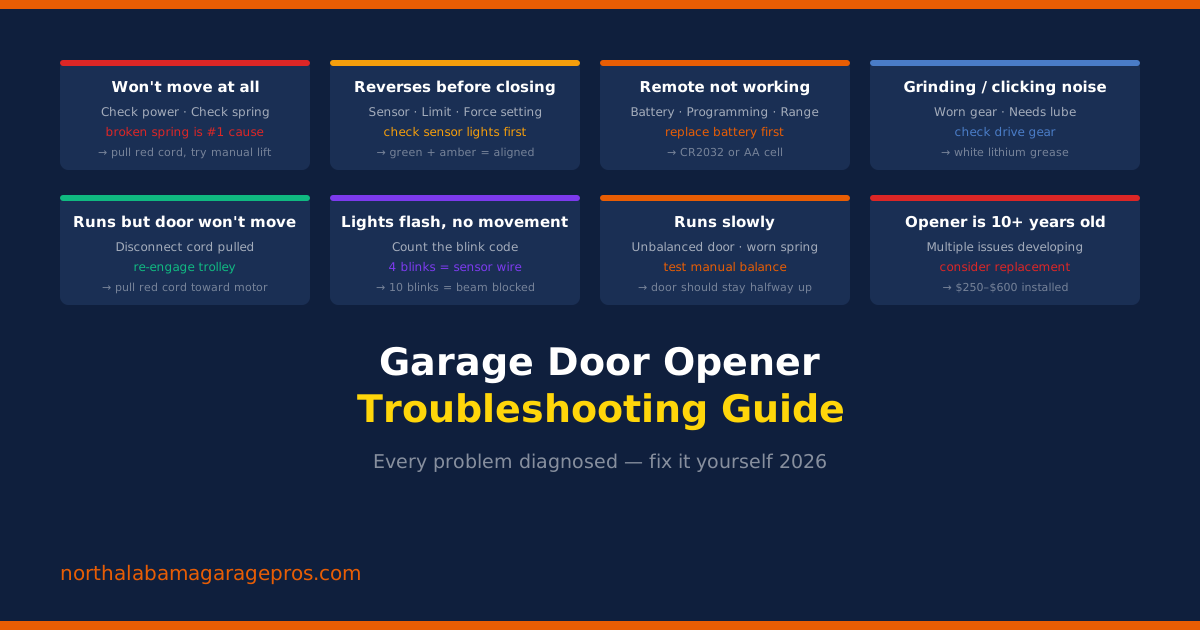
Most garage door opener "failures" are not actually opener failures — they are spring failures, sensor problems, or power issues. Start with the quick checks below before assuming the opener needs replacing.
Quick Checks First — 60 Seconds Before Anything Else
🚨 Is this an emergency? If your spring snapped, cable broke, or door is stuck open, see our emergency garage door repair guide — covers what to do right now and who to call in North Alabama.
- Is the opener plugged in? Check the outlet — also check for a tripped GFCI outlet on the garage wall.
- Is the circuit breaker tripped? Find your panel and look for the garage circuit.
- Is the disconnect cord pulled? If the red cord is hanging loose, the opener is disconnected from the door. Pull it back toward the motor to re-engage.
- Try the wall button. If it works but the remote does not, the opener is fine — the remote needs a battery or reprogramming.
- Replace the remote battery. Most remotes use CR2032 or AA batteries. A dead battery causes 30% of "broken opener" calls.
Problem 1 — Opener Runs But Door Does Not Move
You press the button, hear the motor run, but the door does not move. This is almost always one of two causes:
- Broken spring. The opener cannot lift the door without spring support. Disconnect the opener with the red cord and try lifting manually — if the door is extremely heavy, a spring is broken. Do not continue using the opener. Full spring diagnosis →
- Disconnect cord pulled. The door is in manual mode. Re-engage by pulling the cord back toward the motor head, or simply run the opener — it will reconnect automatically on most models.
Problem 2 — Door Reverses Before Closing
The door goes down a few inches then reverses back up. Work through these in order:
- Check the sensors. Blinking lights = sensor problem. See our guide: should both sensors be green?
- Check for obstructions. Something crossing the sensor beam — even a cobweb — triggers reversal.
- Adjust the close limit. If sensors are fine and no obstructions exist, the travel limit may be set too short. Adjust the "Down" limit screw on the motor head clockwise in small increments.
- Adjust close force. If the door binds or drags slightly, the force sensitivity may be triggering the reversal. Increase close force slightly — but not so much that the 2x4 test fails (door should reverse if a board is placed flat on the ground in its path).
Problem 3 — Remote Not Working
| Symptom | Likely Cause | Fix |
|---|---|---|
| Remote does nothing, wall button works | Dead battery (most common) | Replace battery — CR2032 or AA |
| Remote works close but not from street | Weak battery or signal interference | Replace battery, check for LED lights near sensor |
| Remote used to work, stopped suddenly | Memory full or code erased | Reprogram remote using Learn button |
| New remote won't program | Wrong remote for your opener brand | Verify compatibility — Genie/Overhead Door, LiftMaster/Chamberlain are separate |
| Nothing works — remote and wall button | Power issue or logic board failure | Check power, then call tech |
Problem 4 — Opener Makes Grinding or Clicking Noise
- Grinding on belt/chain drive: The drive may need lubrication. Use white lithium grease on chain drives, silicone spray on belt drives. Never use WD-40 on garage door components.
- Clicking without movement: Usually the trolley carriage trying to engage. Check the drive gear — on older chain drive openers the plastic drive gear wears out after 10–12 years and makes a clicking sound while slipping.
- Loud grinding when opening/closing: Check the door tracks and rollers — a bent track or worn roller causes the noise, not the opener itself.
- Screw drive grinding: The main screw may need lubrication. Use manufacturer-specified grease — never standard oil.
Problem 5 — Opener Lights Flash but Door Doesn't Move
Most LiftMaster and Chamberlain openers use light blink codes to communicate faults. Count the flashes on the motor head light:
- 1 flash: Open sensor — door is not fully closed, safety sensor issue
- 4 flashes: Sensor wire is open or disconnected
- 5 flashes: Sensors are reversed — swap the wires
- 6 flashes: Short in sensor wire
- 10 flashes: Sensor not receiving — check alignment and obstructions
Problem 6 — Opener Is Slow
A slow opener is often just a sign of a poorly balanced door. Disconnect the opener and manually lift the door halfway — it should stay in place on its own. If it falls or rises, the springs need adjustment. A door that is hard to lift manually will run the opener motor slowly and wear it out faster. Spring adjustment guide →
Repair or Replace? The Decision Guide
| Problem | Recommendation | Est. Cost |
|---|---|---|
| Dead remote battery | DIY fix | $5 |
| Sensor misalignment | DIY fix | Free |
| Worn drive gear | Repair if opener < 8 years | $75–$150 |
| Logic board failure | Replace opener if > 10 years | $100–$200 repair / $250–$550 replace |
| Motor burned out | Replace opener | $250–$600 installed |
| 10+ years old, multiple problems | Replace opener | $250–$600 installed |