A garage door that won't close is more than an inconvenience — it's a security issue. Work through this list in order. Most causes take under five minutes to check, and the most common one (sensor misalignment) costs nothing to fix.
Also see: Garage door won't open guide →
The 7 Most Common Reasons a Garage Door Won't Close
🚨 Is this an emergency? If your spring snapped, cable broke, or door is stuck open, see our emergency garage door repair guide — covers what to do right now and who to call in North Alabama.
1
Safety Sensor Misalignment Most Common
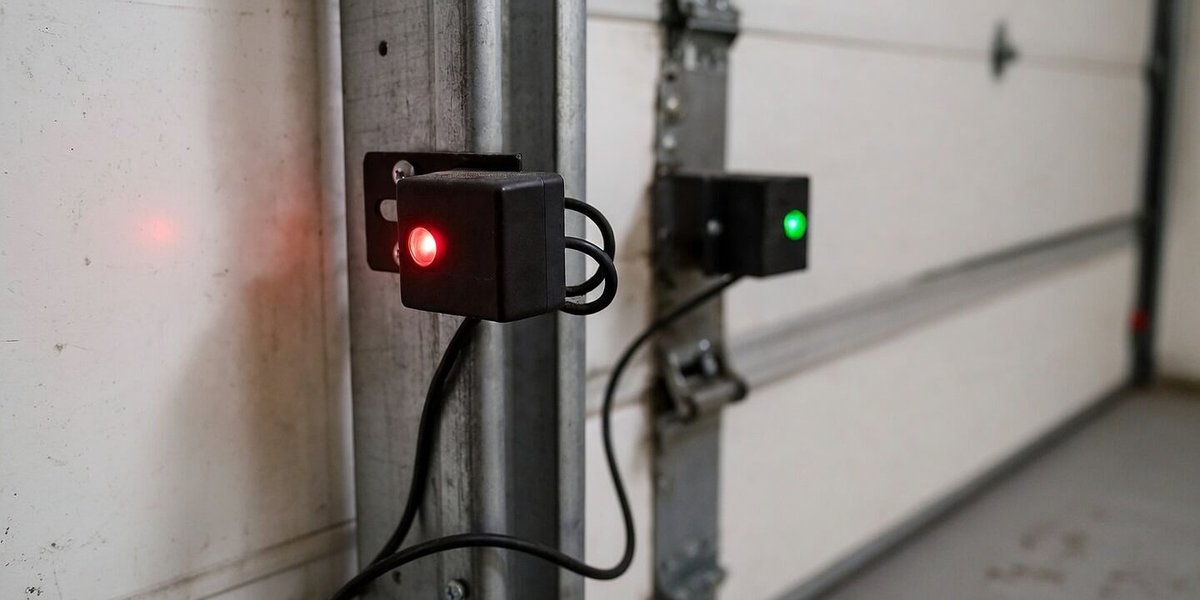
The safety sensors at the bottom of your door track are the most frequent culprit. When they can't "see" each other — because one is bumped, dirty, or blocked — the opener refuses to close the door.
How to diagnose: Look at both sensors (about 4–6 inches off the ground on each side of the door). One should have a solid green light, the other a solid amber. If either is blinking, off, or flickering, that's your problem.
Fix it yourself:
- Clear any debris, cobwebs, or objects blocking the sensor beam
- Wipe both sensor lenses with a dry cloth
- Loosen the wing nut on the misaligned sensor and pivot it until the light goes solid, then retighten
- If nothing works, check the wiring from the sensor up to the motor for any pinched or disconnected spots
Cost if you need a pro: $75–$125. Most techs can diagnose and fix sensor issues in under 30 minutes. See our full sensor repair guide.
2
Something Is Blocking the Sensor Beam
Even if the sensors are perfectly aligned, anything crossing the invisible beam between them will trigger the auto-reverse. The opener thinks something is in the door's path.
Common culprits: A broom handle leaning against the wall, a trash can near the door, a piece of tape on the sensor, a spider web, or even direct sunlight hitting the sensor at the wrong angle.
Fix it: Walk the perimeter of both tracks from sensor to sensor and remove anything within about 12 inches of either sensor. Sunlight interference is trickier — shading the sensor with a piece of cardboard temporarily confirms if that's the cause. Sensor hoods or shields can be added to block direct sunlight permanently.
3
Broken Spring
⚠️ Do not force the door. If a spring is broken, operating the opener will strain the motor and can cause the door to fall suddenly. Call a technician.
A broken torsion spring is the second most common cause of a garage door that won't close properly. Without spring support, the door is too heavy for the opener to handle — it either refuses to move or reverses immediately.
How to diagnose: Look at the horizontal metal shaft above your door. If you see a gap in the tightly wound spring coil, or a piece of spring lying on the floor, it's broken. You'll also notice the door felt extremely heavy if you tried to lift it manually.
What to do: Disconnect the opener using the red emergency cord and leave the door alone until a technician arrives. Spring replacement runs $150–$350 in North Alabama and is nearly always same-day. See our spring repair guide for full details.
4
Travel Limit Set Too High
Every opener has a "close limit" setting that tells it how far to travel before stopping. If this is set wrong, the opener will think the door has hit the floor before it actually does — and since it detects resistance, it reverses to avoid crushing something.
How to diagnose: The door closes partway and reverses, but there's nothing blocking the sensors. The door isn't quite making it to the floor — there may be a small gap.
Fix it: Most openers have limit adjustment screws or buttons on the motor unit. On LiftMaster and Chamberlain, look for two screws labeled "Up" and "Down" (or "Open" and "Close") on the back of the motor head. Turn the "Down" screw a small amount clockwise to increase the travel distance. Test after each adjustment. Consult your opener's manual for the exact procedure for your model.
5
Force Sensitivity Set Too High
Openers have a "force" or "sensitivity" setting that determines how much resistance triggers the auto-reverse safety feature. If this is too sensitive, the door reverses even when there's nothing in the way — just the normal friction of closing.
How to diagnose: The door reverses smoothly without any apparent cause, sensors are aligned, and nothing is blocking the path. Try manually holding the door down gently as it closes — if it stays closed, force sensitivity is the issue.
Fix it: Adjust the "Close Force" or "Down Force" setting on your opener motor head. Increase it slightly and test. Don't increase it too much — the auto-reverse is a safety feature. If the door doesn't reverse when you place a 2x4 flat on the ground in the door's path, the force is correctly calibrated.
6
Door Is Off Track or Binding
If a door panel is bent, a roller has jumped out of the track, or the track itself is bent or misaligned, the door will bind during closing and trigger the reverse mechanism.
How to diagnose: Watch the door carefully as it tries to close. Does it move unevenly, wobble, or seem to hang up at a particular point? Listen for grinding or scraping sounds. Visually inspect the track for dents or gaps where a roller could have popped out.
Fix it: Minor track misalignment (a slightly bent section) can sometimes be gently tapped back into place with a rubber mallet. However, if a roller has jumped the track or the track has a significant bend, this is a job for a technician — forcing a door with track issues can cause serious damage. See our repair guide →
7
Dead Remote Battery or Signal Issue
Simple but easy to overlook — if only your remote won't close the door but the wall button works, the issue is the remote itself, not the door or opener.
Fix it: Replace the battery first (most remotes use CR2032 or AA batteries). If a fresh battery doesn't help, try reprogramming the remote to the opener. LiftMaster and Chamberlain remotes can be programmed by pressing the "Learn" button on the motor head and then pressing the remote button within 30 seconds. If neither fixes it, you may need a replacement remote.
Replacement remotes on Amazon:
Quick Diagnostic Flowchart
Door won't move at all? → Check for broken spring (look at bar above door for gap in coil). If spring is fine, check power to opener.
Door goes down then reverses? → Check sensors first (lights solid?). Then check for obstructions. Then check travel limits.
Only the remote doesn't work? → Replace battery. If wall button works fine, it's the remote, not the door.
Door binds or makes noise? → Look for track damage or rollers off track. Don't force it — call a tech.
None of the above? → The opener's logic board may have failed. Most cost more to repair than replace.
See opener repair guide →
When to Call a North Alabama Technician
If you've worked through the list above and the door still won't close — or if the cause is clearly a broken spring, damaged track, or failed logic board — it's time to call a pro. In North Alabama, these companies offer same-day service for exactly this situation:
★★★★★4.9(340+ reviews)
- ✓ Same-day diagnosis & repair
- ✓ 55+ years, fully stocked trucks
★★★★★4.8(1,349 reviews)
- ✓ 24/7 emergency service
- ✓ Free diagnosis included
Frequently Asked Questions
My garage door closes with the wall button but not the remote — what's wrong? +
The opener is working fine — the problem is the remote. Start by replacing the battery. If that doesn't fix it, try reprogramming the remote using the "Learn" button on the motor head. If neither works, the remote itself may need to be replaced ($25–$45 on Amazon).
Is it safe to manually pull my door down if it won't close? +
It depends on the cause. If sensors are just misaligned, you can override by holding the wall button continuously (don't press and release). If a spring is broken, manually closing the door could be dangerous — the door is extremely heavy without spring support. If you must, get help and use the red emergency cord to disconnect the opener first.
Why does my garage door close partway then reverse? +
The three most likely causes: (1) sensor misalignment — check that both sensor lights are solid, not blinking; (2) the travel limit is set too short and the opener thinks it has hit the floor; or (3) the door is binding somewhere in the track. Work through the list above starting with the sensors.
How much does it cost to fix a garage door that won't close in North Alabama? +
It depends entirely on the cause. Sensor alignment is often free (DIY) or $75–$125 if a tech does it. Broken spring is $150–$350. Opener replacement runs $250–$600 installed. Track repair varies. Get a free diagnosis call from Overhead Door or Precision Door — most companies won't charge for the diagnostic if you proceed with the repair.